What Catholics Should Know About Their Faith
It is my hope that this web page will encourage others to seek more knowledge about their Catholic Faith. As adopted children of God, we should seek the truth about the Father and his only begotten son. We are custodians of all that God created. Holy scripture reveals the good news that our salvation is at hand. Our Father does not want to even loose one of his sheep. It is a fact that each of us will have to meet the word incarnate face to face; one on one and account for all that we have been given and what we have done with the precious gift of life. The Holy Spirit will reveal the word of God to us in a way that cannot be understood any other way. Seek and you will find, knock and it will be opened to you. Many of us never get past the educational level of when we were confirmed. We are all called to follow Christ in some special way. Let us pray for one and other that the inspiration of the Holy Spirit will overcome us with the desire to find out the truth about what our Precious Lord has revealed to us with his life, death and ressurection. The bread of life is the Holy Eucharist; the life of our soul. I would like to hear from you about what you would like to know more about. JUST ASK, AND I WILL DO THE WORK.
May God's will be done in heaven and on earth..
QUIET TIME PRAYER
There is nothing better than older people praying for you. We're not getting
older, just getting closer to home! The instructions are to pick four people
You want God to bless. I pick you.
This prayer is powerful, and prayer is one of the best gifts we receive.
There is no cost but a lot of rewards. Let's always pray for one another.
The Prayer:
Father, Thank You for each and every day You have blessed us here on earth.
Thank You for Your tender mercies. Thank You for giving us friends and family to
share joys and sorrows with. I ask You to bless my friends, relatives, brothers and
sisters in Christ and those I care deeply for, who are reading this right now.
Where there is joy, give them continued joy, Where there is pain or sorrow,
give them your peace and mercy. Where there is self-doubt, release a renewed
confidence. Where there is need, fulfill their needs. Bless their homes, families,
finances, their goings and their comings. In Jesus' name, Amen.
Jesus Christ is "Lord": Priest - Prophet - King
A Child was born to Joseph and Mary and they named hime JESUS
Alleluia, Alleluia, Alleluia
"His Will Be Done"


What Every Confirmed Catholics Should Know
Index of Pages:
-
Home Page - His Will Be Done - Intro to "What Every Catholic Shlould know
-
Sacraments & Creeds
-
Sacraments - Vehicles of Grace
-
URLs of Interest for Catholics and others?
-
Q&A, 10 Commandments, Sins
-
What did Jesus mean when he said not to judge others?
-
Order of the Mass
-
Holy Mass and The Eucharist
-
Presence of Jesus in the Eucharist
-
Adoration of the Eucharist
-
100 Questions-Confirmation
-
Index for Commentary - Word on Fire
-
Commentary on "Word on Fire" 1 (Ten Episodes)
-
Commentary Cont'd Word on Fire" 2
-
Commentary Cont'd Word on Fire" 3
-
The liturgy of the Catholic Church
-
Catholics and Prayer
-
The Psalms ( Study Group)
-
Video Gallery
-
Free Will - What is it?
-
Blog


Click on across from number.
Or, use the drop down menu.
Take up Your Cross Daily and Follow me....
The purpose of this web site is to provide information that Confirmed Catholics should know. I hope to present topics of interest in a manner that is easily understood by the average person. Many Catholics' religious education stopped after Confirmation. I will present information up to Confirmations and beyond. Pope Francis encourages Catholics to get back to the basics of our faith. This will be my goal. Topics such as Sacraments, Creeds, What the Church Teaches and Believes, the Commandments, the Beatitudes, Prayer and the Holy Mass are some of the things that are covered. A Video Gallery with full length movies and commentaries and a Blog page is included. You can even make comments if you like. This web site could be used to supplement an RCIA Program or home schooling.
Another part of the web site is Prayer:
God is ready to hear your prayers, wherever you are, whether with friends or alone. Let’s pray for one another that we become closer to God. That all that we say and do and think are for the good of one another. We should give thanks and praise to our Creator. Be joyful about being born in a free country as Catholics or as Converts to Catholicism. Every breath we take is a gift from God. Give thanks and show gratitude for God's love, mercy, graces and forgiveness. AMEN.
The Catholic Church offers a message that is not its own, but comes from God's self-revelation in Jesus Christ two thousand years ago, yet is ever new and renewing as it is received, celebrated, lived, and contemplated today. The Church offers to all people the possibility of encountering the living God today and finding in him lasting meaningful hope.
Ultimately, every person on this earth will have to meet face to face with our Lord and account for the life they were given. Seems to me that to know God is to Love Him. Scripture says “If you are not with Me, you are against Me” Luke 11:23. I dedicate this web site to my family and in thankksgiving to the Lord for all the love, graces, mercy and forgiveness He has lavished upon all of his adopted children!
Ten Commandments
Source: Catechism of the Catholic Church (Explanation and details can be found on Web Page " Q&A ,10 Commandments, Sins")
First - "I am the Lord your God, you shall not have strange Gods before me. 2133
Second - You shall not take the name of the Lord your God in vain. 2160
Third - Remember to keep holy the Lord’s Day. 2189
Fourth - "Honor your father and your mother" (Deut 5:16; Mk 7:10). 2248
Fifth - You shall not kill. 2318
Sixth - You shall not commit adultery. 2392
Seventh - You shall not steal. 2450
Eighth - "You shall not bear false witness against your neighbor" (Ex 20:16). 2504
Nineth - You shall not covet your neighbors wife. 2528
Tenth - You shall not covet your neighbors goods. 2551
The Two Great Commandment and New Commandment
The Ten Commandments are fulfilled in Jesus' Great Commandment: (1)“You shall love...God with all your heart, with all your soul, with all your mind, and with all your strength....(2) You shall love your neighbor as yourself.” (Mark 12:30-31)
The New Commandment
Before his death on the cross, Jesus gave his disciples a new commandment: “Love one another. As I have loved you, so you also should love one another” (John 13:34).
The Eight Beatitudes
The Beatitudes are the teachings of Jesus in the Sermon on the Mount (Matthew 5:1-10). Jesus teaches us that if we live according to the Beatitudes, we will live a happy Christian life. The Beatitudes fulfill God’s promises made to Abraham and his descendants and describe the rewards that will be ours as loyal followers of Christ.
-
Blessed are the poor in spirit, for theirs is the kingdom of heaven
-
-
Blessed are they who mourn, for they will be comforted.
-
-
Blessed are the meek, for they will inherit the land.
-
-
Blessed are they who hunger and thirst for righteousness, for they will be satisfied.
-
-
Blessed are the merciful, for they will be shown mercy.
-
-
Blessed are the clean in heart, for they will see God.
-
-
Blessed are the peacemakers, for they will be called children of God.
-
-
Blessed are they who are persecuted for the sake of righteousness, for theirs is the kingdom of heaven.
-
Source: The New American Bible
The corporal works of mercy is as follows:
To feed the hungry;
To give drink to the thirsty;
To clothe the naked;
To harbour the harbourless;
To visit the sick;
To ransom the captive;
To bury the dead.
The spiritual works of mercy are:
To instruct the ignorant;
To counsel the doubtful;
To admonish sinners;
To bear wrongs patiently;
To forgive offences willingly;
To comfort the afflicted;
To pray for the living and the dead.
Gifts and Virtues
Theological Virtues
The three theological virtues are faith, hope, and charity
Chief moral virtues
prudence, justice, fortitude, and temperance; these are called cardinal virtues
The seven gifts of the Holy Spirit
wisdom, understanding, counsel, fortitude, knowledge, piety, and fear of the Lord.
The gifts of the Holy Ghost
Help us by making us more alert to discern and more ready to do the will of God.
Fruits of the Spirit
charity, joy, peace, patience, kindness, goodness, faith, modesty, contingency. (Galatians 5:22-23)
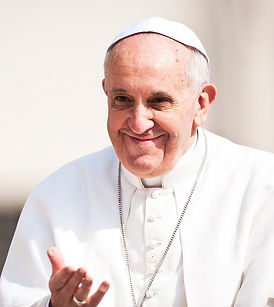
Pope Francis
Click here to visit the Pope's web site <;>)

The Coat of Arms of Pope Francis
DESCRIPTION OF THE COAT OF ARMS
“miserando atque eligendo”
THE SHIELD
Pope Francis has decided to keep his previous coat of arms, chosen at the time of his episcopal consecration and marked by linear simplicity.
The blue shield is surmounted by the symbols of papal dignity, the same as those used by his Predecessor Benedict XVI (the mitre above crossed keys of gold and silver, bound by the red cord). At the top of the shield is the emblem of Pope's religious order, the Society of Jesus: a radiant sun carrying the letters in red, ihs, the monogram of Jesus. The letter h is crowned by a cross; beneath the letters are three black nails.
Lower down on the shield there is a star and spikenard flower. The star, according to ancient armorial tradition, symbolizes the Virgin Mary, the Mother of Christ and the Church; while the spikenard symbolizes St Joseph, Patron of the Universal Church. In traditional Hispanic iconography, St Joseph is shown with a vine in his hand. By bearing these images on his shield, the Pope communicates his special devotion to the Most Holy Virgin and to St Joseph.
THE MOTTO
The motto of Pope Francis is taken from a passage from the venerable Bede, Homily 21 (CCL 122, 149-151), on the Feast of Matthew, which reads: Vidit ergo Jesus publicanum, et quia miserando atque eligendo vidit, ait illi, ‘Sequere me’. [Jesus therefore sees the tax collector, and since he sees by having mercy and by choosing, he says to him, ‘follow me’.]
This homily is a tribute to Divine Mercy and is read during the Liturgy of the Hours on the Feast of St Matthew. This has particular significance in the life and spirituality of the Pope. In fact, on the Feast of St Matthew in 1953, the young Jorge Bergoglio experienced, at the age of 17, in a very special way, the loving presence of God in his life. Following confession, he felt his heart touched and he sensed the descent of the Mercy of God, who with a gaze of tender love, called him to religious life, following the example of St Ignatius of Loyola.
Once he had been ordained a Bishop, H.E. Mons. Bergoglio, in memory of this event that signified the beginning of his total consecration to God in His Church, chose, as his motto and as his programme of life, the words of St Bede: miserando atque eligendo. This he has chosen to keep in his papal coat of arms.
© Copyright - Libreria Editrice Vaticana
http://analytics.catholica.va/piwik/piwik.php?idsite=
"Infallibility of the Pope"
Infallibility
In matters of "faith and morals" as revealed by Jesus Christ himself (Matt. 16:18, 1 Tim. 3:15) the Pope and the magisterium of the Church are infallible.
We have this from Jesus himself, who promised the apostles and their successors the bishops, the magisterium of the Church: "He who hears you hears me" (Luke 10:16), and "Whatever you bind on earth shall be bound in heaven" (Matt. 18:18).
Based on Christ’s Mandate
Christ instructed the Church to preach everything he taught (Matt. 28:19–20) and promised the protection of the Holy Spirit to "guide you into all the truth" (John 16:13). That mandate and that promise guarantee the Church will never fall away from his teachings (Matt. 16:18, 1 Tim. 3:15), even if individual Catholics might.
Vatican II’s Explanation
Vatican II explained the doctrine of infallibility as follows: "Although the individual bishops do not enjoy the prerogative of infallibility, they can nevertheless proclaim Christ’s doctrine infallibly. This is so, even when they are dispersed around the world, provided that while maintaining the bond of unity among themselves and with Peter’s successor, and while teaching authentically on a matter of faith or morals, they concur in a single viewpoint as the one which must be held conclusively. This authority is even more clearly verified when, gathered together in an ecumenical council, they are teachers and judges of faith and morals for the universal Church. Their definitions must then be adhered to with the submission of faith" (Lumen Gentium 25).
Since Christ said the gates of hell would not prevail against his Church (Matt. 16:18b), this means that his Church can never pass out of existence. But if the Church ever apostasized by teaching heresy, then it would cease to exist; because it would cease to be Jesus’ Church. Thus the Church cannot teach heresy, meaning that anything it solemnly defines for the faithful to believe is true. This same reality is reflected in the Apostle Paul’s statement that the Church is "the pillar and foundation of the truth" (1 Tim. 3:15). If the Church is the foundation of religious truth in this world, then it is God’s own spokesman. As Christ told his disciples: "He who hears you hears me, and he who rejects you rejects me, and he who rejects me rejects him who sent me" (Luke 10:16).
RE:
NIHIL OBSTAT: I have concluded that the materials
presented in this work are free of doctrinal or moral errors.
Bernadeane Carr, STL, Censor Librorum, August 10, 2004
IMPRIMATUR: In accord with 1983 CIC 827
permission to publish this work is hereby granted.
+Robert H. Brom, Bishop of San Diego, August 10, 2004

Use of Infallibility
Since 1870 only one statement exercising the Solemn Magisterium has been made,
The only statements of the Pope that are infallible are statements that either reiterate what has always been taught by the Church or are ex cathedra solemn definitions (which can never contradict what has formerly been taught; see e.g. Gal 1:8-9). Infallible statements in the former category are said to exercise the "Universal" or "Constant" Magisterium; infallible statements in the latter category are said to exercise the "Extraordinary" or "Solemn" Magisterium.
Statements that exercise neither the Universal Magisterium or the Extraordinary Magisterium (i.e., statements that do not simply reiterate what has always been taught or which are not solemn definitions expressed ex cathedra) are not infallible, and are said to be an exercise of the merely authentic Magisterium. Such teaching is to be obeyed and given religious assent as long as it does not contradict infallible Magisterium and does not harm the faith or lead to sin.
The conditions required for ex cathedra teaching are mentioned in the Vatican decree:
· The pontiff must teach in his public and official capacity as spiritual head of the Church universal, not merely in his private capacity as a theologian.
.He must be teaching some doctrine of faith or morals in a manner that explicitly and solemnly defines an issue.
· His teaching cannot contradict anything the Church has taught officially and previously.
· It must be evident that he intends to teach with his supreme Apostolic authority. In other words, he must convey his wish to determine some point of doctrine in an absolutely final and irrevocable way. There are well-recognized formulas that are used to express this intention, such as "We declare, decree and define, . . .".
· It must be clear that the Pope intends to bind the whole Church. Unless the Pope formally addresses the whole Church in the recognized official way, he is assumed to not intend his teaching to be ex cathedra and infallible (unless he is reiterating what has always been taught).
· There will be an anathema attached to the definition that outlines consequences for not assenting to it. For ex., in Pope Pius XII's infallible definition regarding the Assumption of the Virgin Mary, there are attached these words, viz: "Hence if anyone, which God forbid, should dare willfully to deny or to call into doubt that which we have defined, let him know that he has fallen away completely from the divine and Catholic Faith."
Invocations of the Pope's Solemn (or "Extraordinary") Magisterium are rare. Since 1870 only one statement exercising the Solemn Magisterium has been made, Pope Pius XII's explicitly defining in 1950 the doctrine concerning the Assumption of Mary into Heaven. Some commentators regard the dogmatic definition of Papal Infallibility itself in 1870, and the dogma of the Immaculate Conception of Mary in 1854, to be other recent examples of infallible pronouncements.
Dissent and Ignorance
Following the first Vatican Council, 1870, dissent, mostly among German, Austrian and Swiss Catholics, arose over the definition of Papal Infallibility. The dissenters, holding the General Councils of the Church infallible, were unwilling to accept the dogma of Papal Infallibility. Many of these Catholics formed independent communities which became known as the Old Catholic Church.
A few Catholics refuse to accept papal infallibility as a doctrine of faith, such as the theologian Hans Küng, author of Infallible? An Inquiry, and historian Garry Wills, author of Papal Sin. Other Catholics appear to be unfamiliar with the significance or meaning of the doctrine. A recent (1989-1992) survey of Catholics aged fifteen to twenty-five from multiple countries (the USA, Austria, Canada, Ecuador, France, Ireland, Italy, Japan, Korea, Peru, Spain and Switzerland), showed that 36.9% accepted the dogma of papal infallibility, 36.9% denied it, and 26.2% said they didn't know. (Source: Report on surveys of the International Marian Research Institute, by Johann G. Roten, S.M.)
According to Catholic theology, to the extent that their rejection of a dogma is deliberate, they separate themselves from the Church and are no longer members of the Body of Christ. In the case of the laymen it is plausible that they are ignorant to the point that they are not culpable; Catholic theology does teach, however, that it is a duty to be familiar with the details of one's faith (e.g., 1 Pet 3:15).